

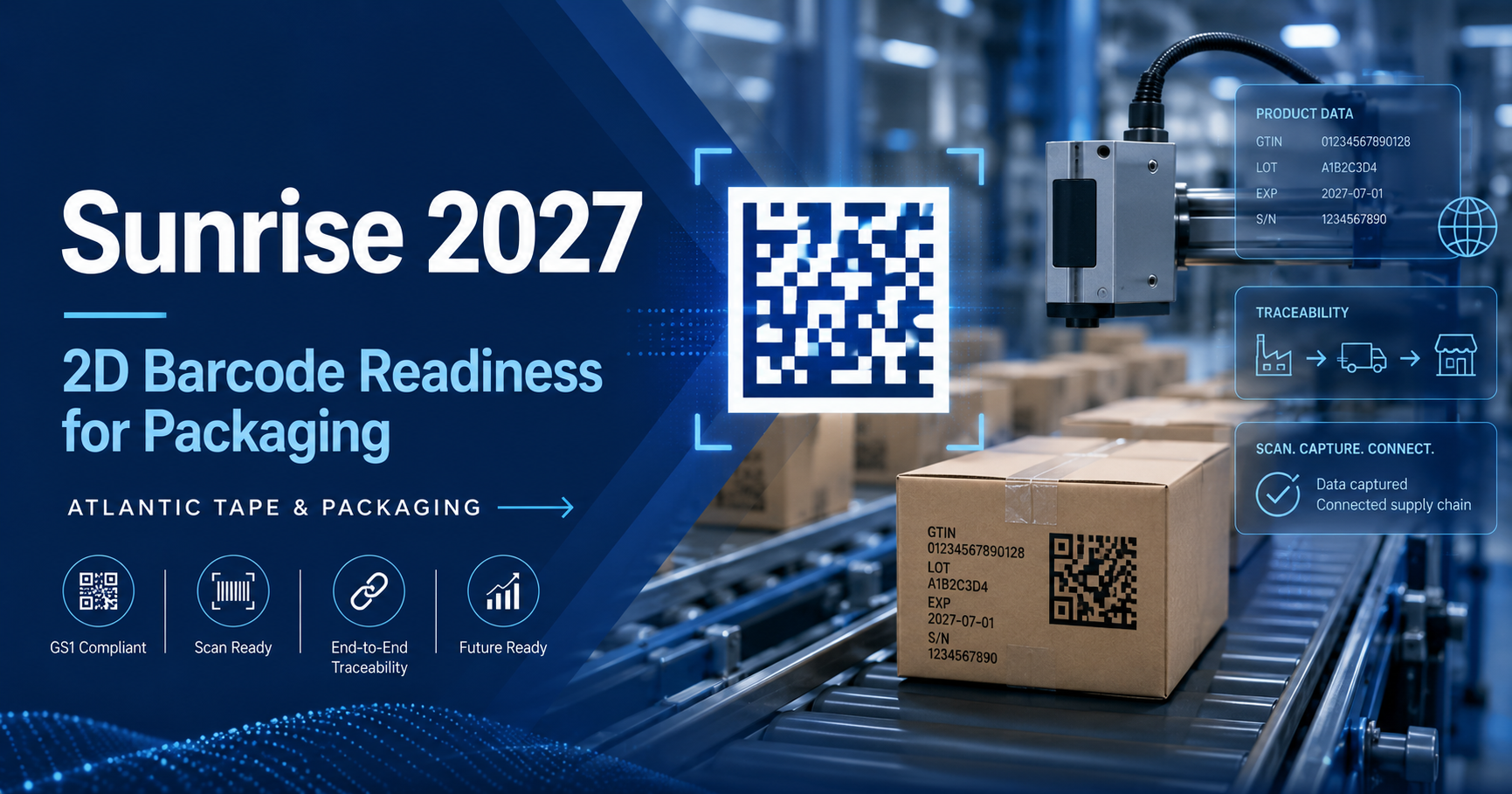
Sunrise 2027 is changing how manufacturers, co-packers, distributors and packaging teams think about product identification. As the retail industry moves toward GS1-compliant 2D barcodes, companies need to review more than the barcode printed on a package. They need to look at packaging materials, coding and marking equipment, labeling systems, print quality, scanner readiness, data structure and production-line performance.
Atlantic Tape & Packaging recently visited SSI Packaging in Richmond, Virginia, to discuss what this transition means for real packaging operations and how companies can begin preparing now.
For many businesses, Sunrise 2027 may sound like a simple barcode update. In reality, it is a much larger shift. It affects how product data is encoded, printed, scanned, verified and shared across the supply chain.
What Is Sunrise 2027?
Sunrise 2027 is the industry’s move from traditional 1D UPC barcodes toward more capable 2D barcodes at retail point of sale. GS1 US describes the initiative as a global transition from 1D UPC barcodes to 2D barcodes, such as QR codes, that can provide greater transparency, stronger traceability and richer data across the supply chain.
The key point is that 2027 is a readiness milestone. GS1’s 2D barcode implementation guidance says the initial goal is for retail point-of-sale systems to be capable of reading and processing the GTIN from both existing linear barcodes and 2D barcodes by the end of 2027. That readiness may require software upgrades and, in some cases, scanner equipment upgrades.
This does not mean traditional UPC barcodes disappear overnight. GS1 notes that linear barcodes will continue to coexist with 2D barcodes where needed, and GS1 US says UPC barcodes will continue to be accepted and scanned after the 2027 sunrise date.
Why Sunrise 2027 Matters for Packaging and Production
Traditional 1D barcodes have served the industry for decades, but they are limited in the amount of information they can carry. A standard UPC is primarily used to identify a product at checkout. A GS1-compliant 2D barcode can carry more information and can also connect the physical product to digital information.
GS1 guidance explains that 2D barcodes can include additional data such as expiration date, batch or lot number and serial number. Through GS1 Digital Link, they can also connect users to web-enabled information such as ingredient details, allergen information, product images, videos, consumer reviews and recycling information.
That creates opportunities beyond checkout scanning, including:
- Better product traceability
- Improved recall readiness
- Stronger inventory visibility
- Product authentication
- Consumer access to product information
- Sustainability and recycling communication
- More connected packaging experiences
An industry article from Matthews Marking also points to the larger challenge, the transition from 1D to 2D barcodes is not something that happens overnight, especially across a large retail and manufacturing landscape.
For packaging and production teams, that means Sunrise 2027 is not just a standards conversation. It is a plant-floor conversation.
What Information Can GS1 2D Barcodes Carry?
A major benefit of the Sunrise 2027 transition is the ability to encode more product-specific data in a standardized way.
GS1 Application Identifiers help define what each data field means. Common examples include:
- GTIN, used to identify the product
- Batch or lot number, used for traceability
- Production date, used for manufacturing records
- Best before or expiration date, used for freshness, safety and compliance
- Serial number, used for unique item-level identification
GS1’s implementation guidance lists common Application Identifiers for retail applications, including GTIN, batch or lot number, production date, packaging date, best before date, expiration date and serial number.
This is an important point for manufacturers and co-packers. A 2D barcode is only useful if the data inside it is structured correctly. A code may look scannable on the outside, but if the data is not formatted correctly, it may not perform the way customers, retailers or downstream systems expect.
Sunrise 2027 Readiness Checklist for Packaging Lines
The goal is not to create unnecessary complexity. The goal is to help companies move from uncertainty to a clear, practical action plan.
A strong Sunrise 2027 readiness plan should review four key areas.
1. Packaging and Print Surface
Every package is different. A code that scans well on a flat white label may perform differently on a glossy pouch, corrugated case, plastic bottle, flexible film, shrink sleeve, carton, can or curved surface.
Key areas to review include:
- Packaging materials and substrates
- Available print area and code placement
- Surface texture, color, contrast and reflectivity
- Curves, seams, shrink areas, flexing or distortion
- Human-readable information placement
This step matters because 2D barcode readability depends on more than the code format. The final result is affected by the package, the surface, the print method, the code size, the contrast and the production environment.
2. Code Format and Data Structure
Companies also need to understand which GS1-compliant 2D barcode format fits their application and what data needs to be encoded.
Key areas to review include:
- QR Code with GS1 Digital Link
- GS1 DataMatrix
- Data Matrix with GS1 Digital Link
- GTIN and variable data requirements
- GS1 Application Identifiers
- Batch, lot, expiration date, serial number or other product-specific data
- Dual-marking requirements during the transition
GS1’s implementation guidance identifies GS1 DataMatrix, QR Code with GS1 Digital Link URI syntax and Data Matrix with GS1 Digital Link URI syntax as 2D barcode options used in the retail POS transition.
3. Equipment and Line Readiness
Sunrise 2027 will have a real impact on production lines. The right code has to be printed clearly, consistently and at production speed.
Key areas to review include:
- Current coding, marking and labeling equipment
- Print method, ink, label and substrate compatibility
- Print resolution, contrast and code durability
- Line speed and production environment
- Code size, error correction and readability
- Testing under real production conditions
Error correction is one example of why production planning matters. GS1 guidance notes that higher QR Code error correction levels can add redundancy, but they can also increase barcode size, which affects packaging, printing and scanning considerations.
4. Scanning, Verification and Systems
Printing the code is only one part of the process. The code also needs to scan properly and connect with the systems that rely on the data.
Key areas to review include:
- Scanner readiness
- Barcode verification
- POS, warehouse, ERP and customer system compatibility
- Data flow through internal and external systems
- Traceability, recall and inventory processes
- Consumer engagement and web-link strategy
GS1 US provides resources for brands, retailers and solution providers, including implementation guidance, test suites and scanner readiness information to help companies prepare for 2D barcode adoption.
GS1 2D Barcode Formats to Understand
As companies prepare for Sunrise 2027, one of the first questions is which 2D barcode format makes sense for the application.
QR Code with GS1 Digital Link
QR Code with GS1 Digital Link can support both retail scanning and consumer engagement. It can encode product identity in a web-enabled format, which allows the same code to connect to digital content while still supporting product identification.
This format may be useful when brands want one code that supports both supply chain needs and consumer-facing experiences.
GS1 DataMatrix
GS1 DataMatrix is already widely used in industries such as healthcare, industrial and logistics applications. It can be a strong option when the available print area is limited or when a compact 2D code is needed.
Data Matrix with GS1 Digital Link
Data Matrix with GS1 Digital Link can support GS1 Digital Link URI syntax in a compact format. This may be useful where space, substrate or printing method makes code size a major consideration.
The right choice depends on the product, packaging, production environment, customer requirements and how the data will be used after scanning.
Dual Marking During the Sunrise 2027 Transition
During the transition, many products may carry both a traditional linear barcode and a GS1-compliant 2D barcode. This is often called dual marking.
GS1 guidance notes that during the dual-marking transition phase, the trade item may feature both the current EAN/UPC barcode and a 2D barcode, such as GS1 DataMatrix, QR Code with GS1 Digital Link URI syntax or Data Matrix with GS1 Digital Link URI syntax.
Placement is important. GS1 guidance states that independent testing showed the 2D barcode needs to be within 50 mm, or 1.97 inches, of the center of the linear barcode to achieve the target retail scanning performance.
That means packaging teams should not wait until the final artwork stage to think about code placement. Barcode location, quiet zone, size, human-readable information and proximity to the existing UPC can all affect scanning performance.
From Barcode Strategy to Plant-Floor Reality
A Sunrise 2027 plan should not stop at choosing a code format. It also needs to answer practical production questions.
Can the code be printed clearly at actual line speed?
Will it remain readable on the finished package?
Does the print method work on the chosen material?
Does the code have enough contrast?
Is the code large enough to scan, but small enough to fit the package design?
Is the human-readable information placed in a way that supports production, customers and retail requirements?
Can scanners and internal systems read and process the data correctly?
These questions matter because the success of a 2D barcode depends on the entire process, not just the code itself.
How Atlantic Tape & Packaging Helps With Sunrise 2027 Readiness
Atlantic Tape & Packaging is helping customers and companies across food and beverage, CPG, pharmaceutical, industrial, logistics, e-commerce and packaging markets prepare for the transition to GS1-compliant 2D barcodes.
Our team can help companies review current packaging operations, identify gaps and build a practical roadmap for Sunrise 2027 readiness.
That may include:
- Reviewing existing coding, marking and labeling equipment
- Testing codes on real packaging materials
- Evaluating print quality and readability
- Reviewing code placement and available print area
- Helping teams understand GS1 data requirements
- Supporting dual-marking planning during the transition
- Preparing for scanner, software and customer-readiness conversations
- Connecting packaging, production and operations teams around one clear plan
Atlantic Tape & Packaging’s equipment resources include categories such as Coding & Marking and Label Applicators, which are directly related to this type of production-line readiness work. The company also supports blank and custom printed labels, including labels with barcodes and variable data.
Why Start a Sunrise 2027 Readiness Plan Now?
GS1 recommends a “crawl, walk, run” approach to 2D barcode adoption. For brands, that can begin with adding 2D barcodes to existing packaging and making sure existing QR codes are updated with GS1 Digital Link standards and include the GTIN. From there, companies can add more data, optimize packaging and eventually use 2D barcodes to support consumer engagement and business processes.
Starting now gives companies time to test, adjust and make smart decisions before the transition becomes urgent.
It also gives teams time to coordinate:
- Packaging artwork updates
- Equipment reviews
- Print testing
- Label and substrate decisions
- Scanner readiness
- Customer requirements
- Internal data processes
- Software and system compatibility
Waiting too long can turn Sunrise 2027 into a rushed compliance project. Starting early turns it into an opportunity to improve traceability, product information, inventory visibility, recall readiness and customer confidence.
Start Your Sunrise 2027 Readiness Plan
Sunrise 2027 is coming, and companies that prepare now will be better positioned for the transition to GS1-compliant 2D barcodes.
Atlantic Tape & Packaging is ready to help customers evaluate their current packaging, coding, marking and labeling systems, test real-world applications and build a clear plan for what needs to happen next.
Thank you to SSI Packaging for the collaboration and the opportunity to discuss how this change will impact real packaging and production environments.
If your team is beginning to evaluate Sunrise 2027, GS1 Digital Link, QR Codes, DataMatrix codes, coding and marking equipment or 2D barcode readiness, now is the time to start the conversation.
Contact Atlantic Tape & Packaging to review your current setup and build a practical Sunrise 2027 readiness plan.